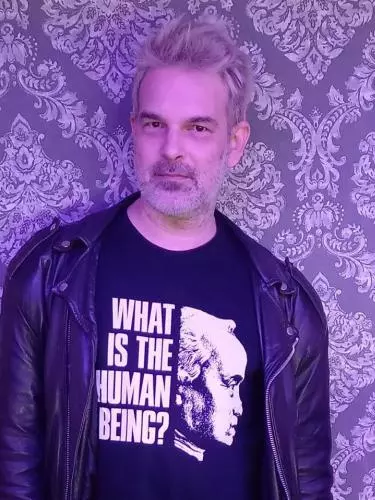
Gergely Nagy earned his PhD at the University of Szeged, Hungary, in 2012. He taught courses on medieval English literature, Tolkien, and various courses in popular culture at the Institute of English and American Studies at Szeged for 16 years. Since 2016, he has been a freelancing translator and an independent scholar. In the early 2000s, he was instrumental in the founding of the Hungarian Tolkien Society, and has been on the editorial board of Tolkien Studies since the journal’s inception. His papers on Tolkien were published over the last 25 years in various edited volumes, and he was invited to contribute to the Routledge Tolkien Encyclopedia (2006), the Blackwell Companion to JRR Tolkien (2014, 2nd ed. 2022), the Oxford Handbook of JRR Tolkien (forthcoming) and the Cambridge Companion to JRR Tolkien (forthcoming)
‘Reading Tolkien in Hungary, Part I: The 20th Century.’ Janka Kascakova and David Levente Palatinus, eds. J.R.R. Tolkien in Central Europe. Context, Directions, and the Legacy (New York and London: Routledge, 2023): 13-33.
‘Reading Tolkien in Hungary, Part II: The 21st Century.’ Janka Kascakova and David Levente Palatinus, eds. J.R.R. Tolkien in Central Europe. Context, Directions, and the Legacy (New York and London: Routledge, 2023): 34-57.
‘Mi a Tolkien-szöveg?’ [‘What Is a Tolkien Text?’] IGyIC Online 2021, https://igyic.hu/esszektanulmanyok/mi-a-tolkien-szoveg.html
‘On No Magic in Tolkien: Resisting the Representational Criteria of Realism.’ Dimitra Fimi, Thomas Honegger, eds. Sub-Creating Arda: World-building in J.R.R. Tolkien’s Work, its Precursors and its Legacies (Zürich and Jena: Walking Tree, 2019): 163-76. Also in: Hither Shore 14 (2017): 8-24.
‘The Silmarillion: Tolkien’s Theory of Myth, Text and Culture.’ Stuart Lee, ed. A Companion to J.R.R. Tolkien (Oxford: Wiley-Blackwell, 2014): 107-118. (2nd ed.: Oxford: Wiley-Blackwell, 2022: 180-196)
‘A Body of Myth: Representing Sauron in The Lord of the Rings.’ Cristopher Vacarro, ed. The Body in Tolkien’s Legendarium. Essays on Middle-earth Corporeality (Jefferson: MacFarland, 2013): 119-132.
‘Nincs több mentség – A Tolkien-kutatások Magyarországon.’ [‘No More Excuses: Tolkien Studies in Hungary’] Andrea Nagy, Dóra Pődör, eds. J.R.R. Tolkien: Fantázia és erkölcs [J.R.R. Tolkien: Fantasy and Morality] (Budapest: Károli Gáspár Református Egyetem, Magyar Tolkien Társaság, 2012): 13-17.
‘Fictitious Fairy Tales: Writing a Fictitious Character in The Lord of the Rings.’ Anna Kérchy, ed. Postmodern Reinterpretations of Fairy Tales. How Applying New Methods Generates New Meanings (Lewiston, Lampeter: The Edwin Mellen Press, 2011): 367-382.
‘J. R. R. Tolkien tudományos munkája: az író és a kritikus.’ [‘J.R.R. Tolkien’s Academic Work: the Writer and the Critic’] J. R. R. Tolkien, Szörnyek és ítészek (Szeged: Szukits, 2006): 351-363.
‘Authorship’, ‘Fictionality’, ‘Gollum’, ‘Orality’, ‘Plato’, ‘Reception of Tolkien (Hungary)’, ‘Silmarillion’, ‘Subject Theory and Semiotics’, ‘Textuality’. Michael D. C. Drout, ed. J.R.R. Tolkien Encyclopedia: Scholarship and Critical Assessment (New York and London: Routledge, 2006), 44-45; 203-204; 246-248; 486-487; 513-514; 288-289; 608-612; 627; 642-643.
‘The ‘Lost’ Subject of Middle-earth. Elements and Motifs of the Constitution of the Subject in the Figure of Gollum in The Lord of the Rings.’ Tolkien Studies 3 (2006): 57-79. (Reprint: Children’s Literature Review 152 (2010))
‘The Medievalist(’s) Fiction: Textuality and Historicity as Aspects of Tolkien’s Medievalist Cultural Theory in a Postmodernist Context.’ Jane Chance and Alfred Siewers, eds. Tolkien’s Modern Middle Ages (The New Middle Ages, New York: Palgrave Macmillan, 2005): 29-41. (Reprint: Stuart Lee, ed. J.R.R. Tolkien. Critical Assessments of Major Writers. Routledge (2017): 29-41.)
‘The Adapted Text: The Lost Poetry of Beleriand.’ Tolkien Studies 1 (2004): 21-41.
‘Saving the Myths: the Recreation of Mythology in Plato and Tolkien.’ Jane Chance, ed. J. R. R. Tolkien and the Invention of Myth: A Reader (Lexington: University Press of Kentucky, 2004): 81-100. In Greek: ‘Σώζοντας τους Μύθους: Η αναβίωση της μυθολογίας στον Πλάτωνα και στον Τόλκιν’ Dimitra Fimi, Dimitris Kolovos, eds. Επιδράσεις της Αρχαίας Ελληνικής Γραμματείας στο έργο του Τζ. Ρ.Ρ. Τόλκιν (Athén: Κέδρος, 2021): 397-426.
‘The Great Chain of Reading: (Inter)Textual Relations and the Technique of Mythopoesis in the Túrin Story.’ Jane Chance, ed. Tolkien the Medievalist (London: Routledge, 2002): 239-58.
Tolkien and Alterity (2017), edited by Christopher Vaccaro and Yvette Kisor. Journal of Tolkien Research: Vol. 6: Iss. 1 (2018), Article 7. Available at: http://scholar.valpo.edu/journaloftolkienresearch/vol6/iss1/7
Tolkien in the New Century: Essays in Honor of Tom Shippey (2014), edited by John Wm. Houghton, Janet Brennan Croft, Nancy Martsch, John D. Rateliff, and Robin Anne Reid. Journal of Tolkien Research: Vol. 4: Iss. 1 (2017), Article 7. Available at: http://scholar.valpo.edu/journaloftolkienresearch/vol4/iss1/7
Verlyn Flieger, Interrupted Music. The Making of Tolkien’s Mythology. Tolkien Studies 3 (2006): 173-177.
Tom Shippey, The Road to Middle-earth. Harmadik, bővített és javított kiadás. Tolkien Studies 2 (2005): 258-261.
‘That Fantastic Century. The Tolkien Phenomenon, Tolkien Criticism, and Tom Shippey’s J.R.R. Tolkien: Author of the Century.’ The Anachronist (2002): 327-38.